
Sadly, the precise locations of many medieval battles are uncertain. This, however, is not the case with the Anglo-Burgundian victory at Cravant, on Saturday 31 July 1423. Contemporary accounts more or less agree as to both the line of approach of the two armies and also to the flow of the fighting; which, as it was along and across the river at Cravant is easy enough to follow.
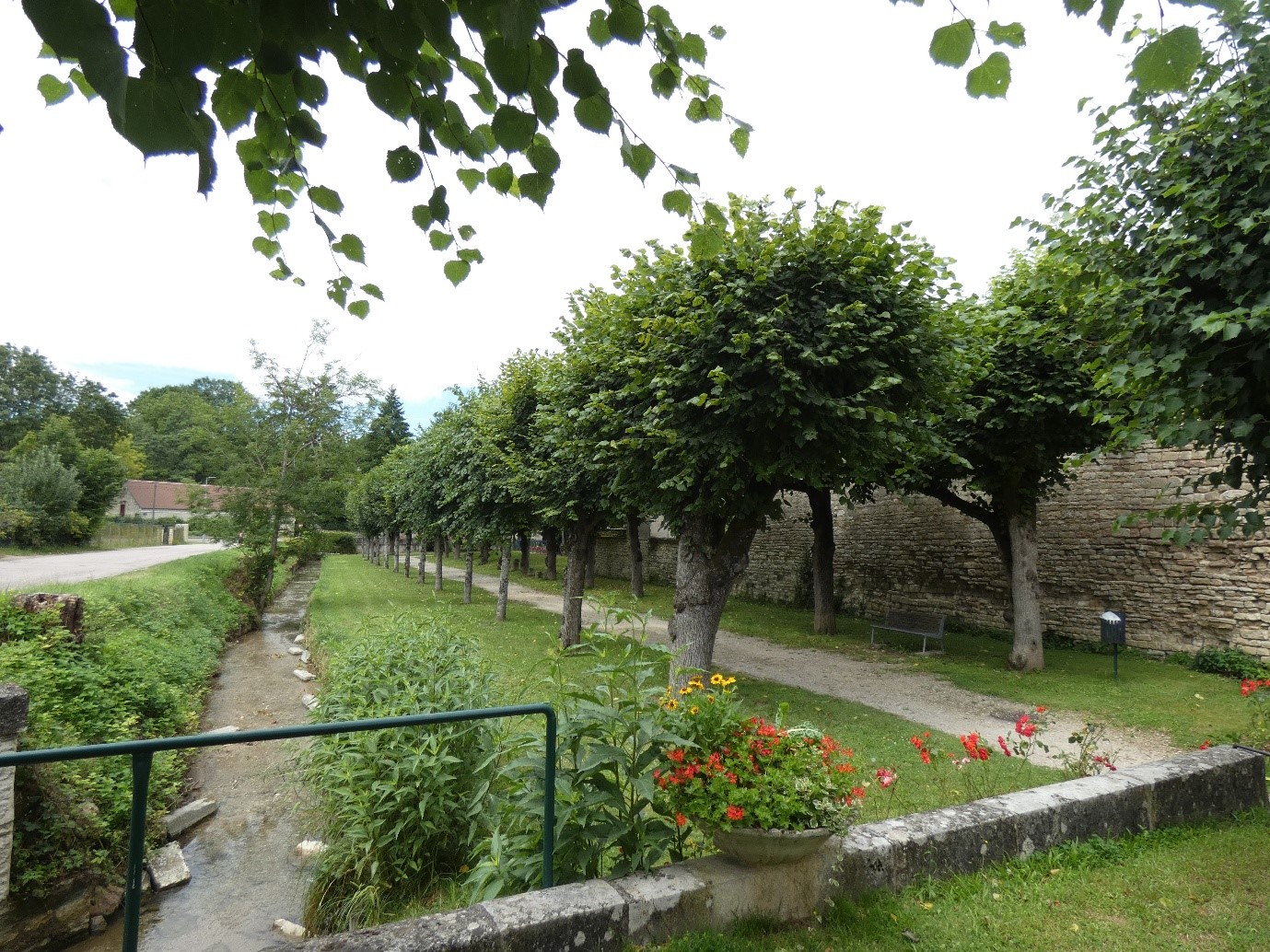
A portion of the surviving town walls at Cravant (2024)
The walled town of Cravant, on east bank of the River Yonne, held by the Burgundians, was besieged by a large army of perhaps six or seven thousand troops loyal to the Dauphin, supplemented by a sizeable Scottish force commanded by John Stewart of Darnley. How long the siege had lasted when word reached the Burgundians of the garrison’s plight is unclear but the warrior chronicler, Jehan de Wavrin, makes plain that the situation was desperate: “their towers and walls were so battered with mortars and cannon [and] they were so much oppressed with famine that they ate their horses, and bled them to obtain the blood; their was neither cat nor dog, rat nor mouse within which they had not eaten up.”
There was no time to lose therefore and although the military situation elsewhere was by no means untroubled, an English army of “in all about four thousand combatants”, according to Wavrin, was despatched under the command of the earls of Salisbury, of Suffolk and Lord Willoughby. They rendezvoused with a smaller force of Burgundians at Auxerre, a dozen or so miles to the north west.
Wisely, as they were about to take the field against a powerful enemy, the wary allies met at a council of war held in Auxerre’s cathedral to agree both strategy and tactics for the coming fight. It was then proclaimed, for the benefit of all, that both the English and Burgundians would “be good friends together”, advancing and fighting under two marshals, and with an advance guard of 120 men-at-arms, with supporting archers, drawn equally from the two contingents.
The army would fight on foot, the horses to be sent to the rear on encountering the enemy. Archers would also carry stakes, pointed at both ends, which could be rapidly deployed (hammered into the ground) as protection against enemy horsemen. It was also agreed that no prisoners should be taken (for their ransoms) until the outcome of the battle was clear and that no-one should ride out of their station. Food for two days would be carried and fresh rations delivered thereafter by the people of Auxerre (“who should be well paid for it”).
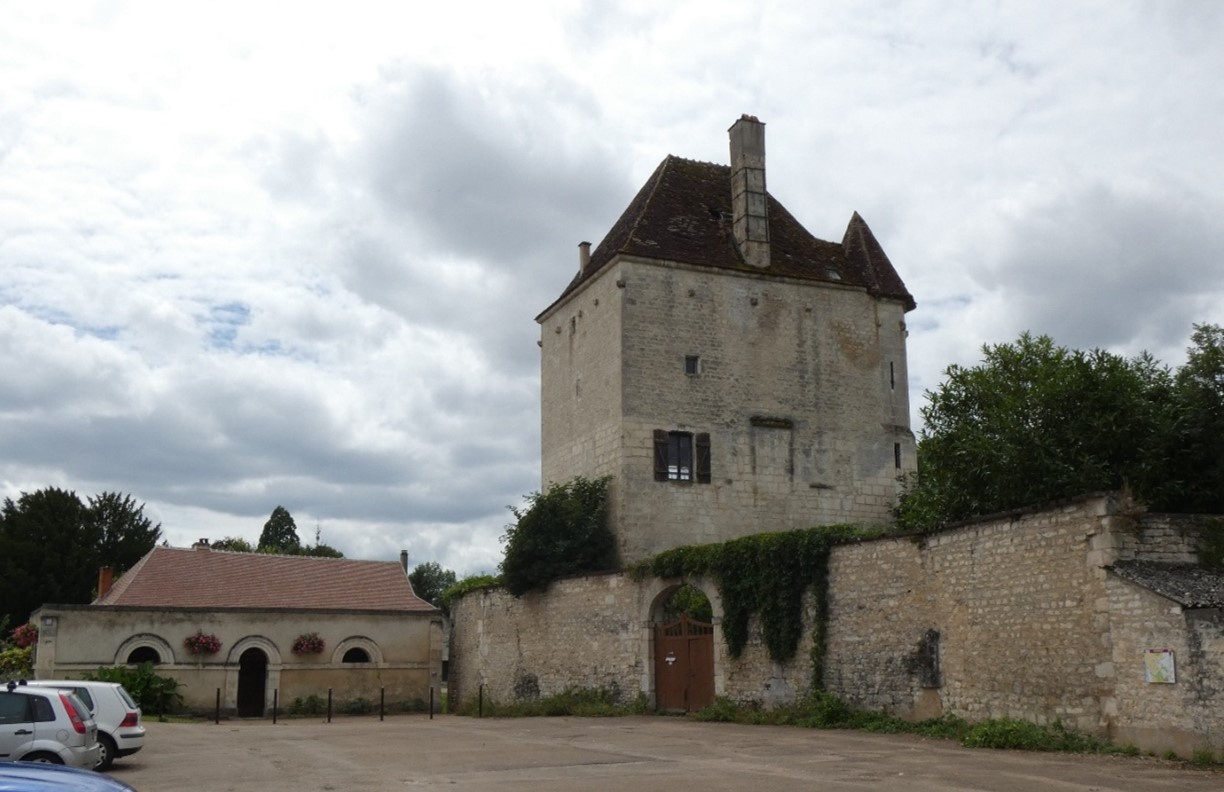
The ’donjon’ and surviving walls at Cravant.
In good heart, therefore, the Allied army set off south from Auxerre, probably down the old Roman road (now the D239). According to Wavrin, they reached the village of ‘Vaucelles’ and settled for the night. This is almost certainly Vincelles, which is just over three miles from Cravant, fitting well with the chronicler’s description of the encampment as “one league from their enemies”.
The following morning the Anglo-Burgundian army continued towards Cravant. It seems likely that, at first, they crossed the River Yonne in order to approach Cravant from the north, unhindered by the need to force a passage across a bridge in enemy hands. It is a pleasant approach, even today, along the shaded banks of the Yonne but the road passes through what would to a mediaeval army have been a dangerously narrow defile between ‘La Belle Vue’ hill and the river.
Here, on the slopes of the hill, it is likely that the French and Scots had prepared for battle, leaving enough troops behind them to continue the blockade of the town. It was a strong position and so the Anglo-Burgundians turned again, recrossed the Yonne and deployed for battle along the riverbank with the bridge and road into Cravant at their centre. Lord Willoughby took command on the right and Lord Salisbury the left.The French and Scots lined the farther river bank, with their backs to the town walls.
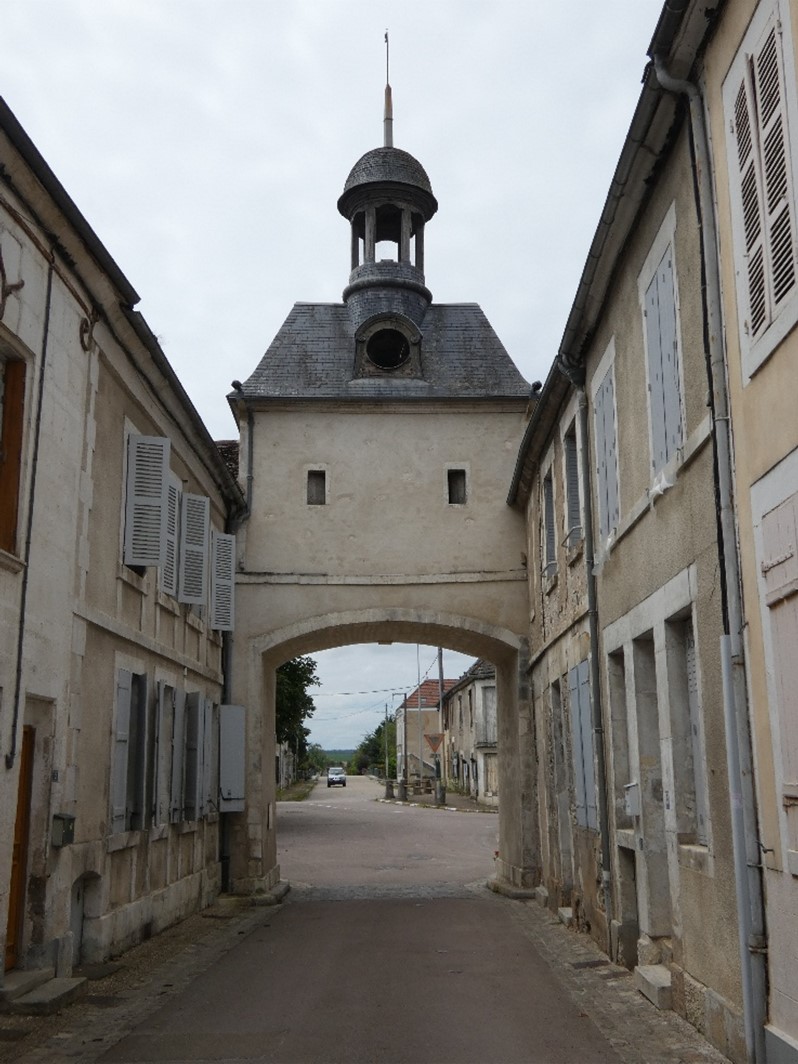
Cravant’s Porte d’Orléans with the River Yonne bridge in the background.
The River Yonne, in July, is seldom either deep or fast flowing. Presumably in 1431 it was the same, facilitating the earl of Salisbury’s crossing and recrossing the stream. Once arrayed for battle on either side of the river, for some hours neither side cared to move. Arrows and other missiles doubtless flew across the river but it was not until the earl of Salisbury plunged into the river, with a cry of “St George!”, that fighting became general.
Lord Willoughby’s banner was then seen amidst the press of fighting on the bridge “piercing,” according to Wavrin, “through the Scotch and French with blows of lances, axes, and swords.”
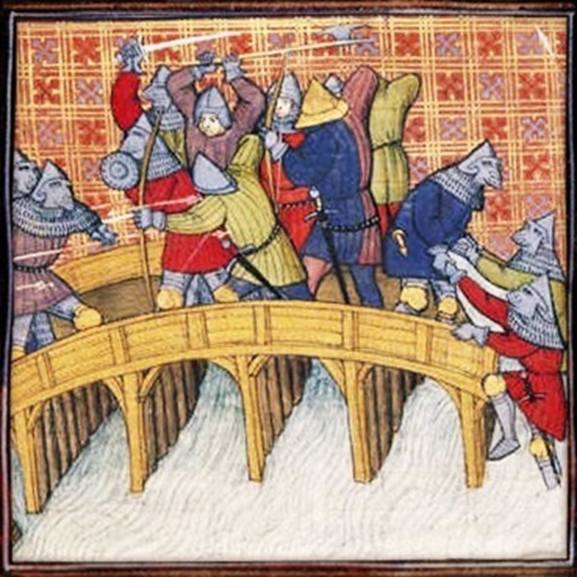
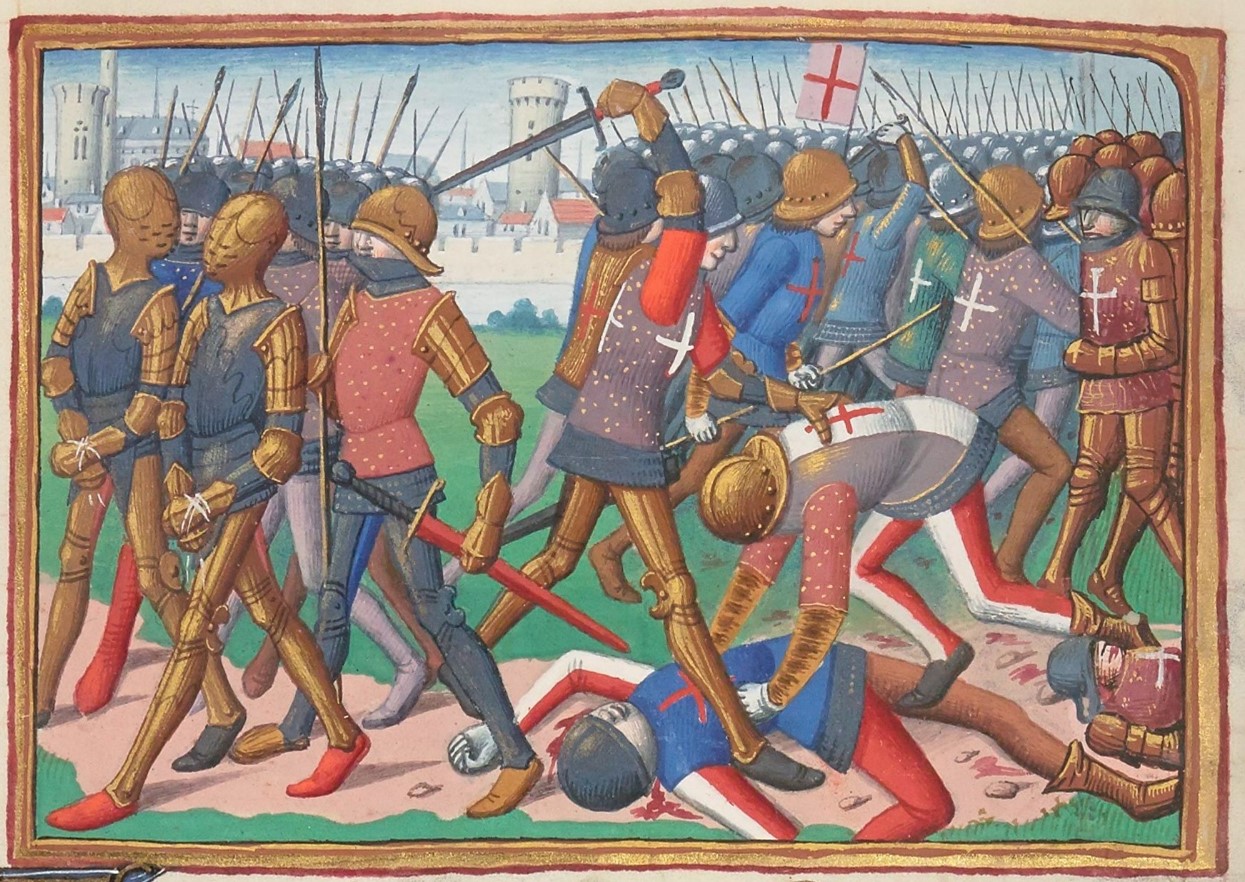
Fierce fighting at Cravant: the rout has begun and two prisoners, their hands tied, are being led away for ransom.
As the French and Scots began to give way, an attack was made into their rear by the physically weak, but still clearly game, defenders of Cravant. Although “enfeebled and broken down with famine”, according to Wavrin, the garrison burst out of Cravant, and “crying their war cries, they killed and cut down their enemies so impetuously that it was terrible to behold.” The battle became a rout and finally the victorious English and Burgundians felt free to begin to take prisoners rather than cut down their foe.
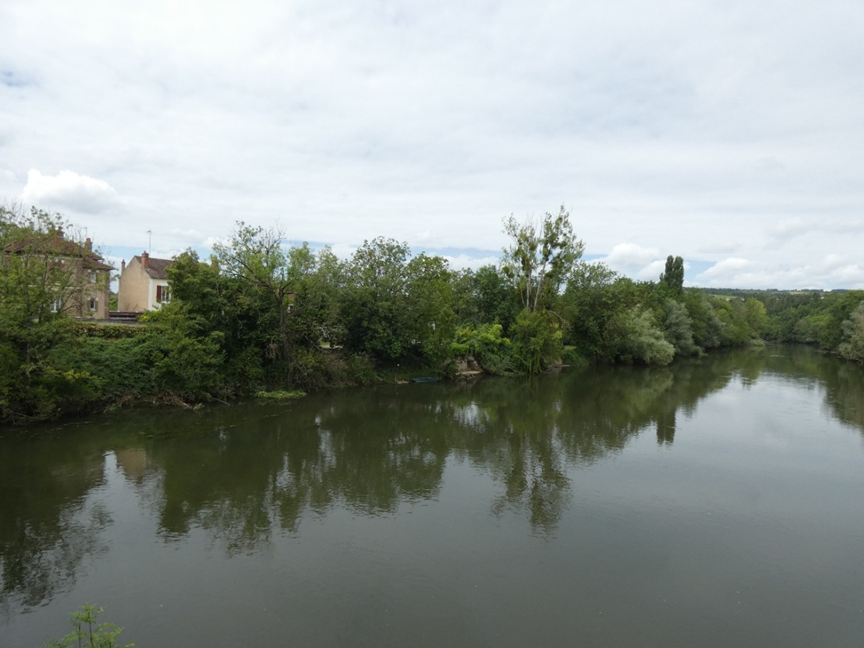
The Western riverbank – the starting point of Salisbury’s ‘battle’ or division of the English army, seen from the bridge. Dozens of skeletons were discovered here when a new bridge was built in 1760.
Cravant was relieved and the allies “entered into the town… thanking the Creator for their fair victory.” The riverbank and fields about Cravant were littered with dead and wounded. Wavrin thought the Scots suffered most, losing some four thousand, with over a thousand more Frenchmen killed or captured. English and Burgundian losses must have been considerable too but armies in flight always suffer far more, once soldiers turn their backs to escape.
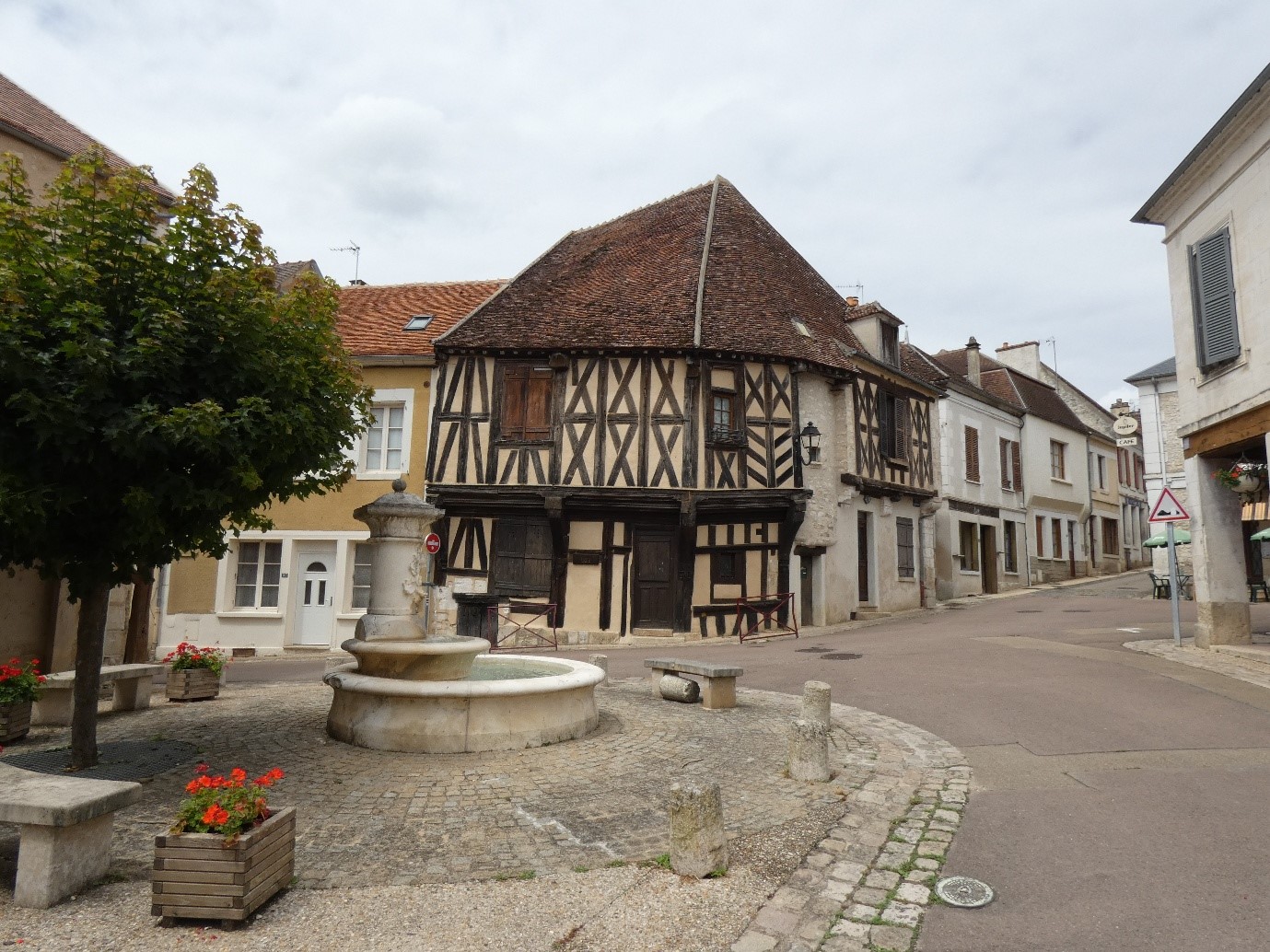
Cravant is still a partially walled town and some of the streets inside are narrow and twisting. Parking is easy enough however and refreshment may be found. There is a strong stone tower, the ‘donjon’, beside a dusty car-park, with an avenue of trees leading thence to the Porte d’Orléans and the road across the River Yonne. It is easy to imagine the battle, with men-at-arms and archers lining both banks, beneath their banners, and then the plunging assault across the green water and up the slippery farther bank.
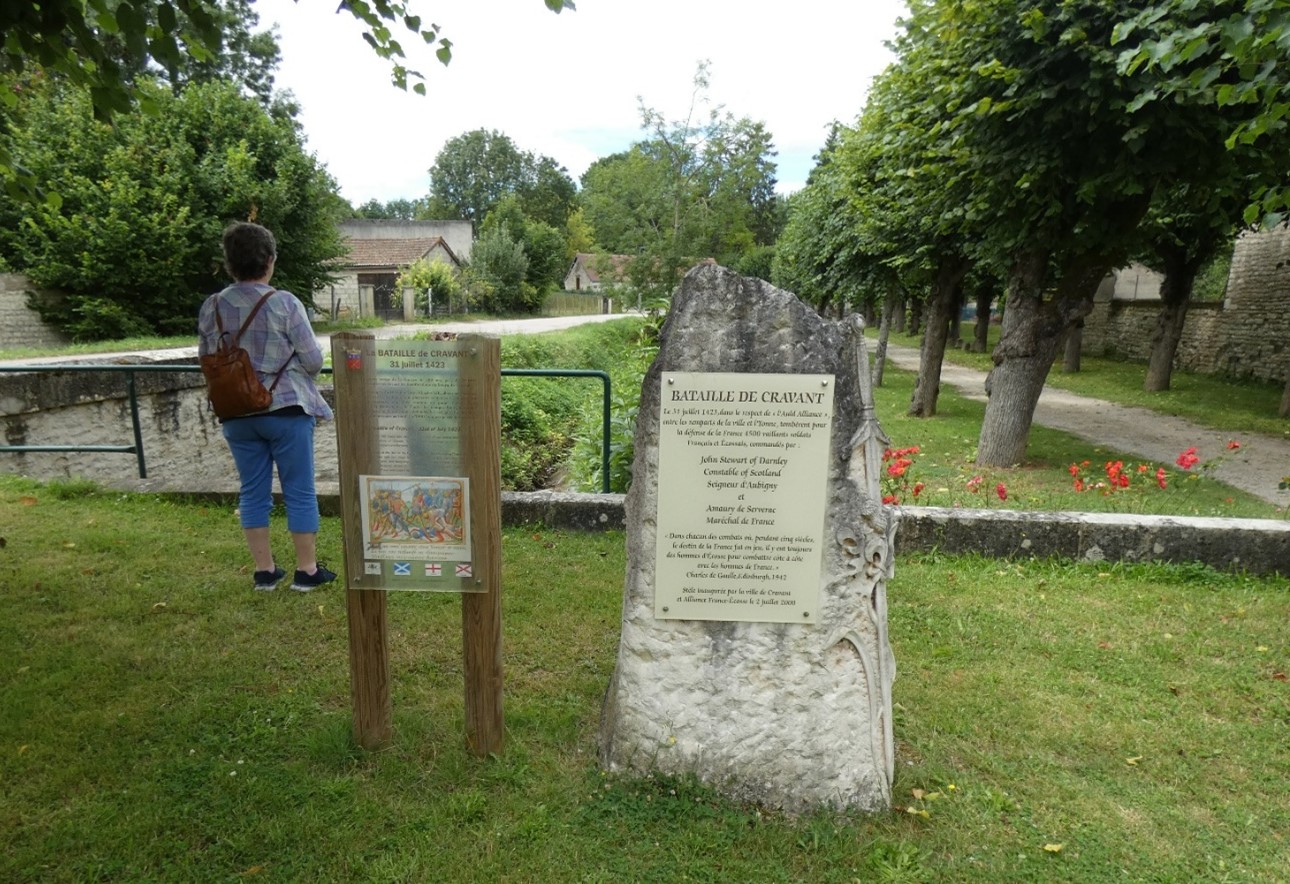
On the battle’s 600th anniversary Cravant enjoyed a medieval fair and produced a souvenir booklet on the battle. Visiting a year later we found a copy in the bar where we lunched but were deterred from purchasing what had probably been originally given away by a monumentally over-avaricious patron. There are memorials to be seen, in a small park or garden beside the ‘donjon’; one from 2000 set up by the Alliance France-Écosse and another, less partial, from the Mairie de Cravant, featuring the flags of (royal) France, Scotland, England and Burgundy.
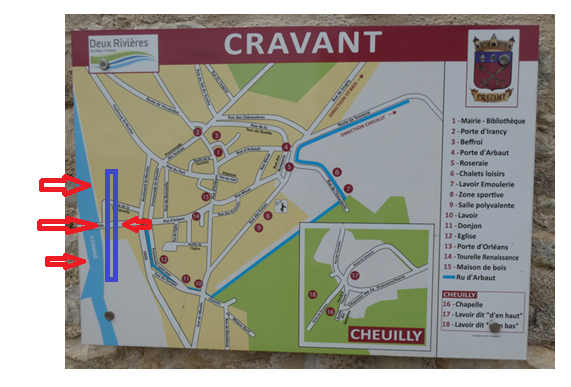
The battlefield at Cravant: the Armagnacs and Scots (in blue) assailed by both Lords Salisbury’s and Willoughbys English and their Burgundian allies (from the West) and the Burgundian garrison from within the Porte d’Orléans.